It was Greenock Fair this weekend, and no one even mentions it. No buzz, no banners, nothing to say it’s holiday time.
It’s strange now. Nothing changes on the streets. The kids might be off school, but business carries on as usual. No big shutdown. No shift in the air.
Back in the 70s, when we were kids, it was a big deal. Greenock Fair always fell on the closest weekend to the beginning of July, and it kicked off a two-week break. After week one, it was Paisley’s Fair Saturday, and as ours ended, the Glasgow Fair began. I’m not even sure how much of a thing it is in Glasgow anymore.
When we were young, families planned for it. You’d head down to Battery Park and meet up with all your cousins. Everyone looked forward to it.
And then there was the envelope, always a small brown one. Your parents or grandparents would hand it over quietly. The wee ones might get a half crown, the older ones a ten bob note. It felt like felt like we’d won the pools.
Greenock was bursting with working men’s clubs back then, football supporters’ clubs, factory clubs, Masonic halls, a wide range of places that people met to socialise (the original social network). There must have been thirty or more, and they were all busy. It was these clubs that took the kids away on Fair Saturday. I remember the Morton Club taking busloads of us down to Stevenson in Ayrshire. Everyone got an apple, an orange, and a 20p piece for sweets.
The buses were pure chaos, kids singing, some being sick, while the adults cracked open their half bottles and dragged out rusting deckchairs that had been rescued from a cellar and dusted off once a year.
Greenock town centre was best avoided on Fair Friday. The pubs were rammed with men straight out of the yards, shouting, roaring, fighting sometimes. But it wasn’t just about the chaos, it marked something bigger: the start of the Fair Fortnight.
The whole town came to a stop. Factories, the yards, everything shut down. The long lines of buses that used to queue outside the yards vanished. The cranes stopped lifting ship parts. The engine works at Kincaid’s fell silent. Our house stopped vibrating—just for two weeks—after months of round-the-clock testing of the ship’s engines. The most noticeable change was the silence on the streets. No crowds of men in boiler suits and flat caps, covered in oil and grease, pouring out the gates toward the pubs or the buses.
It was also a time of envy. You’d see the one lucky family on your street heading off to a caravan park on the East Coast in their second hand Leyland Rover. The car packed to the roof, with three adults in the long bench seat in the front, one with a wean on their knee and the grandparents and more kids squashed together, in the back and not a seatbelt in sight.
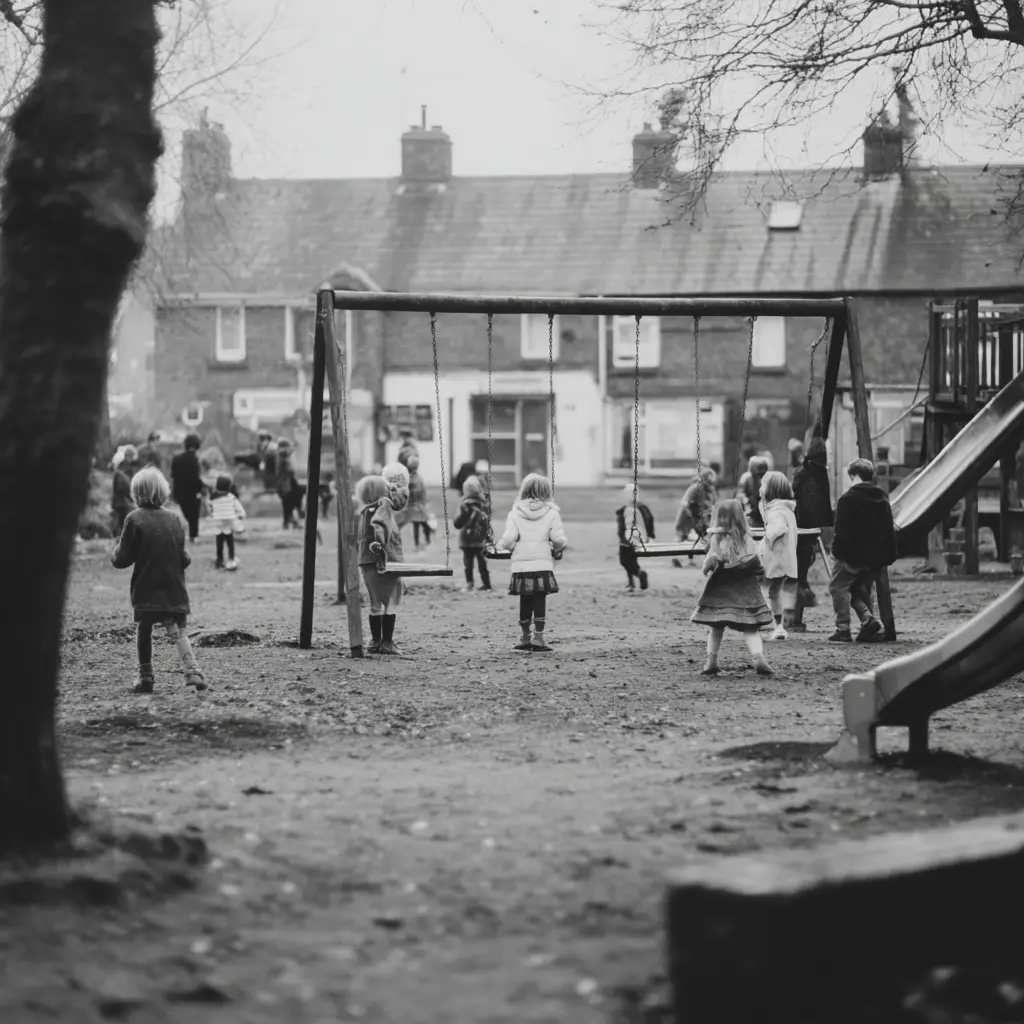
For those of us staying put, the streets were ours again. For some reason the sun always shone during these holidays and so we’d dig out old shoe polish tins to play hopscotch, chalking lines on the pavements. If someone had a ball, it was football or kerby, bouncing it off the kerb and catching it to score. The girls played elastics, dead simple but great fun. You never see this now. If there were any rainy days I can’t remember them. Maybe we forget those days as nothing much would have happened short of a visit to the Hector McNeil baths or staying home and reading an Enid Blyton book as there was nothing on the telly.
Outside we became adventurers. We roamed far beyond our usual patch, no phones, no tracking, heading off to some concrete surfaced play park (the council really thought these through) to cling to the witches’ hat or tackle those climbing frames designed to maim or kill. And we loved every minute of it.
Of course, with the holidays in full swing, something funny happened to all the dads and uncles too, they all became car mechanics. Bonnets up, socket sets out, Haynes manuals at the ready, cylinder heads off, oil filters chucked, cars jacked up on bricks. God knows what they were actually doing, but it kept them busy. They used to go to the local ‘scrappy’ and thought nothing of climbing up a stack of scrap cars, three or four high, just to strip a door off or yank off some vital part like a wing mirror and bring it back to append to their pride and joy.
As the yards reopened, our mums went back too, most of them worked in the shipyard canteen. There was some kind of unspoken agreement with management that us kids were allowed to eat free every day during the school holidays. I remember one day, lines of men squashed in on long benches, all eating soup, or sausage and mash, and right in the middle of it, seven of us kids all in t-shirts and shorts, happily eating amongst the smell of oil and grease. It was the best food we got back then.
I remember a couple of the men were queuing with their plates, grumbling about there being no seats left because of “those bloody kids.” But the canteen lady, Faye, looked them straight in the eye and said, “Do you want fed or do you want to leave?” The power of the canteen wummin’, never underestimate them. He he!
That’s my recollection. Maybe your Fair was different. Maybe you were one of the lucky ones and actually got away for a week.
All I know is this, as I drove to work this Fair Monday feels like any Monday now, but I still hear Faye’s voice asking, ‘Do you want fed or not?