Hi Everyone,
With all the scare stories in the press, one million NEETs, a forgotten generation, plus the added scare stories of AI taking over the world and everyone sitting around doing nothing, it has me questioning a lot about AI and the nonsense written about it. I’ve come to the conclusion that many people are asking the wrong question (that’s not to say that I ask all the right ones).
For me, we have to get away from the question, “Is AI going to replace me?” which seems to be getting bandied around in every story these days.
Instead, we should stay focused and ask ourselves:
“What could I achieve if I became really good at using AI?”
That, to me, is the crux of the matter.
Every new technology gets flooded with scare stories. Calculators would kill our numeracy skills. Personal computers would take over and we’d all be out of jobs. Driverless cars would be dangerous. Yet, so far, when measured by the number of hours driven compared to humans, driverless cars are proving to be far safer than human drivers.
My observation has always been that new technologies always add a layer of fear at first because people fear change. Then, once we adopt them, our human ingenuity kicks in and we, in tandem with the technology, usually create something bigger and better than before. The once frightening technology becomes the everyday norm until another disruptor comes along.
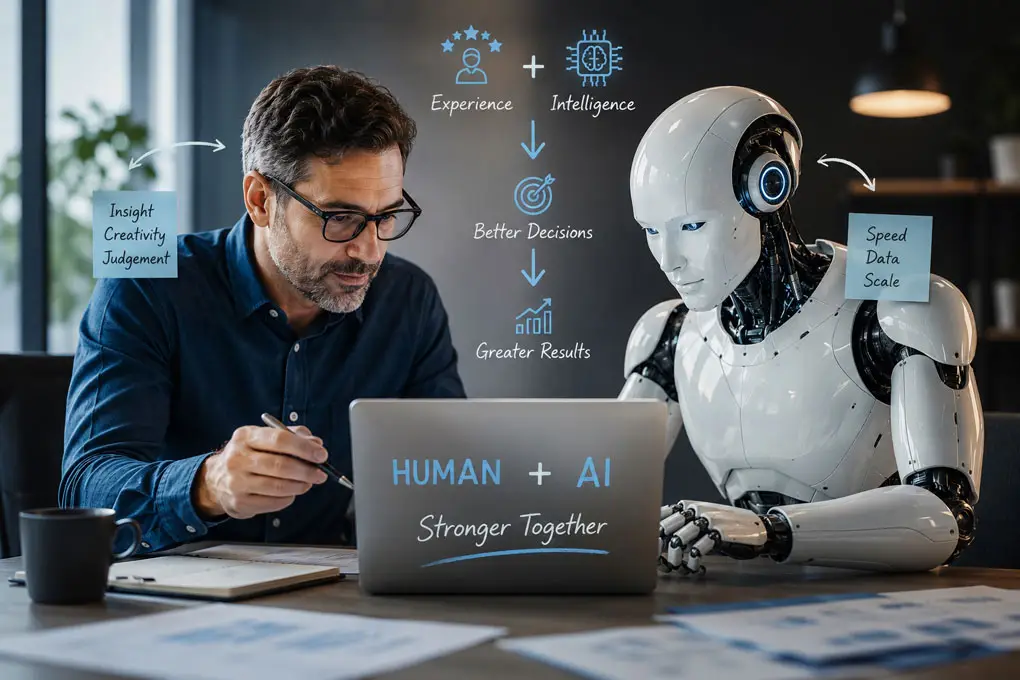
There’s an old adage that goes along the lines of “the whole is greater than the sum of its individual parts”.
In other words, when you combine two things properly, the result can be worth far more than either could produce on its own.
Maybe I’m naïve, but that’s how I see AI.
If you take a skilled accountant and add AI, together they can create better results than either one working alone. It’s the same with engineers, designers, business owners, scientists and countless other professions. All of them can produce greater results and outcomes using AI than they can on their own.
That only applies of course if we drop the idea that the person sits back and lets AI do all the work. It has to be a joint adventure.
The obvious mistake, for me, is people assuming the value lies in the tool, the AI engine. It doesn’t.
The value lies in the person and their level of creativity in using it.
I remember many years ago someone on television saying that a Stradivarius in the hands of an amateur will often sound horrific, while a cheap £20 violin in the hands of a concert violinist can sound incredible.
To me, that’s experience plus tool.
Since ChatGPT, Gemini, Claude and others burst onto the scene, they have given us access to an incredible number of answers. But when we come back to the basics of our chosen field, it’s our experience that helps us know which answers are wrong.
That’s where our own expertise comes in.
While AI can undoubtedly generate ten possible solutions to a problem, an experienced person knows which ones are practical, which ones are nonsense, and which ones are most likely to deliver results.
Think of an engineer being given better tools or a surgeon being given better imaging equipment. We wouldn’t come to the conclusion that the engineer or surgeon is no longer needed. What we’d expect is for them to push the boundaries further and produce better results, more quickly, with the improved tools.
That’s why I don’t believe the naysayers who avoid AI over the coming years will be the winners. Nor do I think the people who blindly hand everything over to AI and contribute very little themselves will win either. The gains will come from those of us who learn how to combine our experience and industry knowledge with these new tools.
So will jobs be lost because of AI? Almost certainly.
Will some industries disappear or be radically transformed? History suggests they will.
But that isn’t really the whole story. When the motor car arrived, it reduced the need for blacksmiths and carriage makers, yet it created mechanics, garages, driving instructors, road builders, logistics companies and countless other industries that had never existed before. The same happened with electricity, aviation, personal computers and the internet.
Every major technological shift destroys some opportunities and creates others.
The real question isn’t what jobs will disappear, it’s what new jobs, industries and opportunities will emerge because of these technologies, and whether we’re preparing ourselves to take advantage of them.
My suspicion is that the biggest winners won’t be the people who resist change, but those who learn to work alongside it and find new ways to create value for others.
At Toltech, that’s exactly what we’re doing: helping our clients push forward, embrace the new technology and making sure they remain relevant in their marketplace and not be left behind. We’re helping clients become more visible online by combining nearly three decades of digital experience with AI-powered tools that help us analyse markets, identify opportunities, understand competitors, improve content and focus our time and effort where they matter most.
Yes, AI helps us work faster, and our experience helps us know which questions to ask, which opportunities to pursue and which distractions to ignore.
If you can step back and look at how the whole is greater than the sum of the parts, you might see that this isn’t about human versus AI, but human plus AI. Which together produce results, greater than the sum of the parts.
Embrace AI and see if you can drive better results for your clients. If you don’t, your competitors probably will.
Have a great weekend everyone.
Grahame
Please Note. Article written from top to bottom by me, (human) tidied up spellchecked, grammar fixes etc., by AI and some suggestions by AI to enhance my idea. ;0)